SDK Development & Specialized Integrations
Published on · Updated · 6 min

I develop Swift SDKs for various domains:
Hardware communication — Bluetooth (BLE, Classic MFi), NFC, accessories
Security & cryptography — encryption layers, authentication, secure enclave
Processing & AI — OCR, vision, Apple Intelligence, on-device models
Media — video generation, audio processing, streaming
Network APIs — REST, GraphQL, WebSocket, gRPC
Cross-platform bridges — Swift ↔ C, Unity (C#), Flutter
“I transform complex technologies into elegant Swift APIs.”
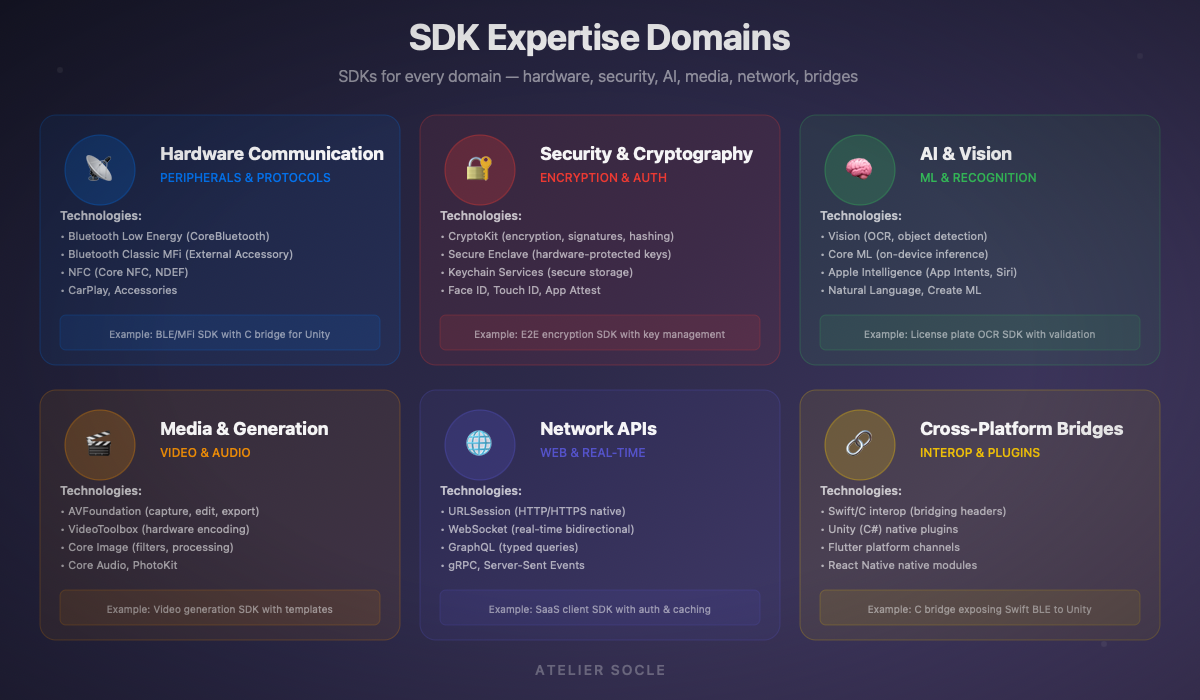
SDK Expertise Domains
Hardware Communication
SDKs for communication protocols with peripherals.
Technologies:
- Bluetooth Low Energy (BLE) — CoreBluetooth, scanning, GATT
- Bluetooth Classic MFi — External Accessory, Apple certification
- NFC — Core NFC, NDEF, tag reading/writing
- Accessories — MFi, CarPlay, External Accessory
Example mission: BLE/MFi communication SDK with C bridge for Unity (C#) integration.
Complexities handled:
Connection state machines
Retry and automatic reconnection
Permission management
Background modes
Proprietary protocols
Security & Cryptography
SDKs for advanced security features.
Technologies:
- CryptoKit — encryption, signatures, hashing
- Secure Enclave — hardware-protected keys
- Keychain Services — secure storage
- Local Authentication — Face ID, Touch ID
- App Attest — app integrity
Example mission: End-to-end encryption SDK with key management and secure storage.
Complexities handled:
Key lifecycle management
Encryption schema migration
Compliance (GDPR, certifications)
Performance on large volumes
Processing & Artificial Intelligence
SDKs for vision, recognition and ML models.
Technologies:
- Vision — OCR, object detection, classification
- Core ML — on-device models, inference
- Apple Intelligence — App Intents, Siri, system actions
- Create ML — custom training
- Natural Language — text analysis
Example mission: Specialized OCR SDK for license plate recognition with country-specific validation.
Complexities handled:
Real-time optimization (live camera)
Accuracy vs performance
Edge case handling
Fallbacks and corrections
Media & Generation
SDKs for content processing and generation.
Technologies:
- AVFoundation — capture, editing, export
- VideoToolbox — hardware encoding/decoding
- Core Image — filters, processing
- Core Audio — audio processing, effects
- PhotoKit — library access
Example mission: Video generation SDK with templates, overlays and multi-format export.
Complexities handled:
Performant rendering pipeline
Memory management (large files)
Multiple formats and codecs
Progress and cancellation
Network APIs
SDKs for web services and real-time.
Technologies:
- URLSession — native HTTP/HTTPS
- WebSocket — bidirectional real-time
- GraphQL — typed queries
- gRPC — performance, streaming
- Server-Sent Events — server push
Example mission: Complete client SDK for SaaS API with auth, pagination, caching.
Complexities handled:
Authentication (OAuth, JWT, API keys)
Retry, exponential backoff
Offline support, sync
Rate limiting
Cross-platform Bridges
SDKs with interoperability to other languages/platforms.
Technologies:
- Swift/C interop — bridging headers, unsafe pointers
- Swift/Objective-C — mixed codebases
- Unity (C#) — iOS native plugins
- Flutter — platform channels
- React Native — native modules
Example mission: C bridge exposing a Swift BLE SDK for Unity/C# consumption.
Complexities handled:
Cross-boundary memory management
Threading and dispatch
Type mapping
Error propagation
Design Principles
Idiomatic Swift API
A good Swift SDK follows language conventions:
Expressive Error Handling
Errors should guide the developer:
Native Testability
The SDK should be mockable without gymnastics:
Typical SDK Structure
Typical Deliverables
Complete SDK
Swift Package — source code, SPM ready
DocC Documentation — API reference, articles, tutorials
Example app — feature demonstration
Tests — unit, integration, possibly UI
CI/CD — GitHub Actions or equivalent
For Cross-platform Bridges
C Headers — exported interface
Native plugin — Unity/Flutter/RN ready
Integration documentation — step-by-step guide
Example project — Unity/Flutter/RN side
Engagement Formats
SDK Design & Implementation
Complete SDK creation.
Deliverables:
Complete Swift Package SDK
DocC documentation
Example app
Tests
Integration guide
Duration: 2-8 weeks (depending on complexity)
Existing SDK Audit
Analysis and recommendations.
Deliverables:
Audit report (API design, performance, testability)
Prioritized recommendations
Refactoring estimation
Duration: 3-5 days
Specialized Integration
Encapsulating a technology for internal use.
Deliverables:
Isolated integration module
Mocks for testing
Usage documentation
Duration: 1-4 weeks
Best Practices
Distribution
| Method | Usage |
|---|---|
Swift Package Manager | Recommended standard |
XCFramework | Closed binaries, proprietary code |
CocoaPods | Legacy, if necessary |
Semantic Versioning
MAJOR — breaking changes
MINOR — backward-compatible new features
PATCH — bug fixes
Documentation
DocC — Xcode integrated, symbols + articles
README — quick start, installation
CHANGELOG — version history
MIGRATION — guides between major versions
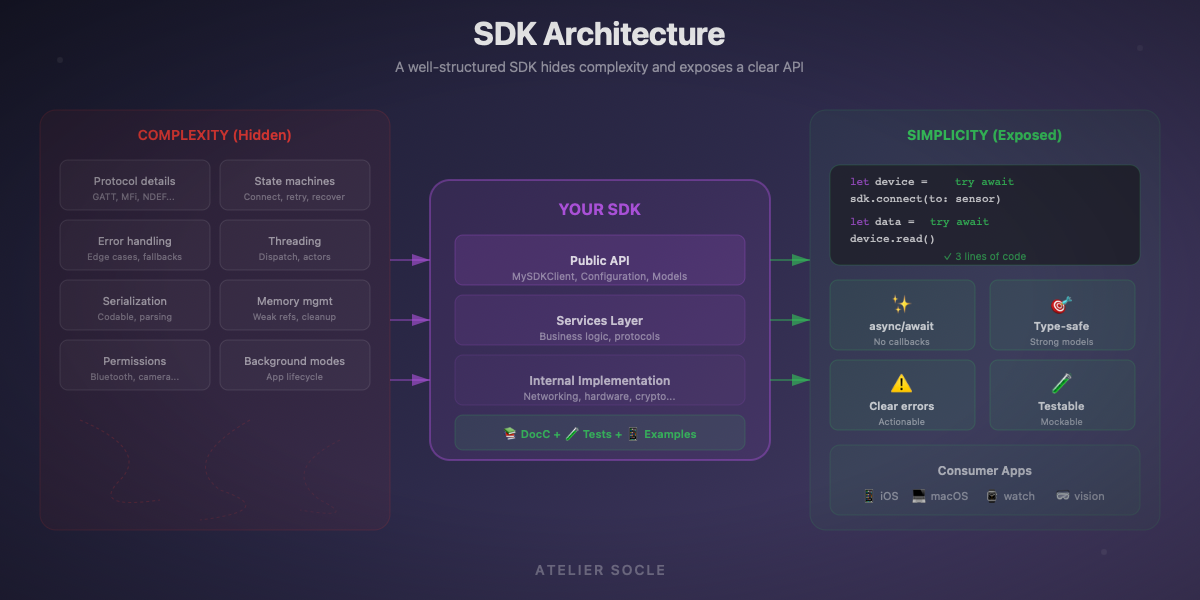
“A good SDK hides complexity and exposes simplicity — whether it's Bluetooth, crypto, or a REST API.”
Good to know
- Not full app development → see Apple Applications
- Not general architecture → see Swift Architecture
- Not global optimization → see Performance
Here, we focus on encapsulating and exposing specialized functionality.
Frequently Asked Questions
"Can you make an SDK for [technology X]?"
If it runs on Apple (iOS, macOS, watchOS, tvOS, visionOS), I can probably encapsulate it. Bluetooth, NFC, crypto, ML, video, networking — each domain has its specifics, but good SDK design principles remain the same.
"How to handle MFi certification for Bluetooth Classic?"
The SDK can be developed in parallel with the MFi process. I know the technical constraints (External Accessory framework, proprietary protocols) and can support you on the technical aspects of certification.
"Should an SDK support iOS 15 or can we target iOS 17+?"
It depends on your audience. For a public SDK, iOS 15+ covers ~95% of devices. For internal or B2B use, you can often target newer and benefit from the latest APIs.
"How to test a hardware SDK without the physical device?"
Mockable architecture from design, simulators when available (BLE simulator), and integration tests on real devices in CI (via Mac + connected device or cloud service).