Swift Architecture & Modularization
Published on · Updated · 5 min

Does your Swift codebase need structure? I help you with architecture and modularization:
Architecture audit — analysis of your current code, identification of friction points
Modularization plan — strategy for splitting into Swift Package Manager modules
Progressive migration — guidance on refactoring without breaking everything
Architecture from scratch — setting up a healthy structure from the start
Pattern definition — choosing and implementing an appropriate pattern (MVVM, TCA, Clean...)
“This service focuses on structure. I help you design and implement the architecture — not develop your features.”
Why invest in architecture?
A well-structured project isn't a luxury — it's an investment that pays off quickly:
| Common Problem | Symptoms | Impact |
|---|---|---|
Monolith | Explosive build times, constant merge conflicts | Team productivity divided by 2-3x |
No separation | Impossible tests, cascading bugs | Maintenance cost x5 |
Circular dependencies | Impossible to reuse code | Duplication, technical debt |
No conventions | Every dev does differently | Slow onboarding, endless reviews |
“Good architecture doesn't slow down development — it accelerates it in the long run.”
Architecture Patterns
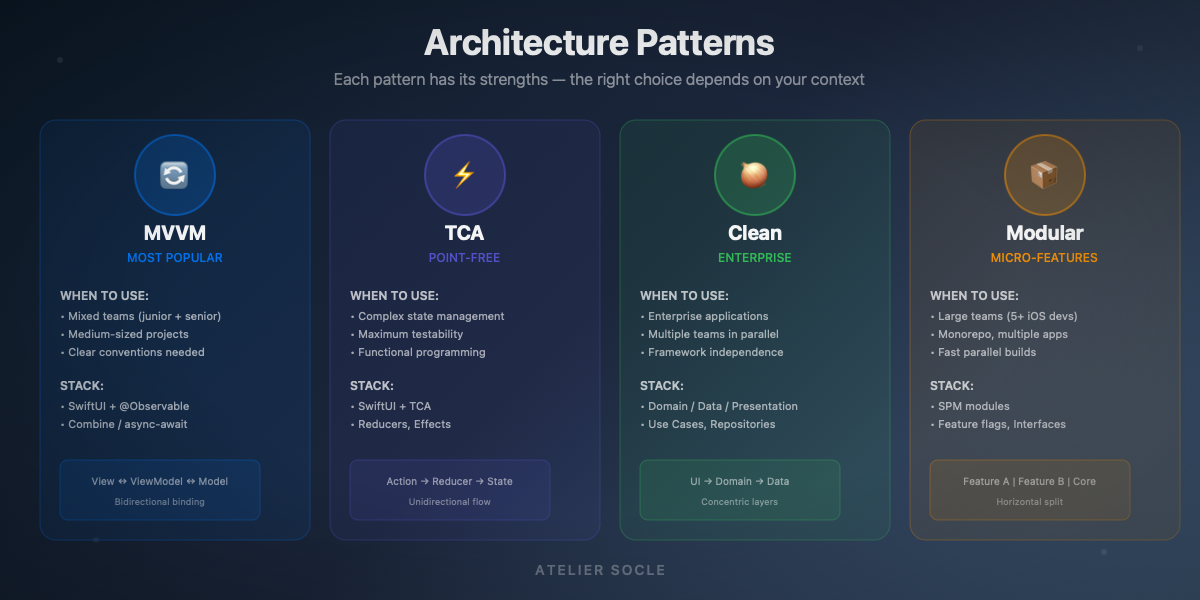
MVVM (Model-View-ViewModel)
The most widespread pattern on iOS. Simple to understand, compatible with SwiftUI and UIKit.
| Advantages | Disadvantages |
|---|---|
Simple and well documented | Can become "Massive ViewModel" |
Perfect for SwiftUI | Navigation sometimes unclear |
Testable (isolated ViewModel) | No global state management |
Ideal for: Medium-sized apps, teams new to architecture, SwiftUI-first projects.
TCA (The Composable Architecture)
Framework by Point-Free. Unidirectional, composable, highly testable.
| Advantages | Disadvantages |
|---|---|
Predictable global state | Learning curve |
Composable by design | Verbosity (Reducer, Action, State...) |
Deterministic tests | Framework dependency |
Ideal for: Complex apps with lots of state, experienced teams, long-term projects.
Clean Architecture
Strict separation into concentric layers (Entities, Use Cases, Interface Adapters, Frameworks).
| Advantages | Disadvantages |
|---|---|
Layer independence | Significant initial setup |
Maximum testability | Over-engineering if not balanced |
Suited for large teams | Lots of boilerplate |
Ideal for: Enterprise projects, multiple teams, strict maintainability requirements.
Micro-features
Feature-based splitting into independent SPM modules. Each feature = 1 package.
| Advantages | Disadvantages |
|---|---|
Fast incremental builds | Requires discipline |
Strong isolation | Dependency graph complexity |
Easy reuse | SPM tooling still limited |
Ideal for: Monorepos, feature teams, modular apps.
Modularization with SPM
Swift Package Manager has become the standard for modularization. Here's a typical structure:
Modularization Benefits
| Metric | Before Modularization | After Modularization |
|---|---|---|
Clean build time | 5-10 min | 1-2 min |
Incremental build time | 30-60 sec | 5-10 sec |
Merge conflicts | Daily | Rare |
Test coverage | < 30% |
|
New dev onboarding | 2-3 weeks | 3-5 days |
Types of Engagement
Architecture Audit
Complete analysis of your codebase:
Dependency mapping
Anti-pattern identification
Technical debt measurement
Prioritized recommendations
Duration: 2-5 days depending on project size Deliverable: Audit document + findings presentation
Modularization Plan
Splitting strategy adapted to your context:
Target module definition
Dependency graph
Migration order
Effort estimation
Duration: 3-5 days Deliverable: Modularization plan + roadmap
Migration Support
I work with your team to migrate progressively:
Extraction of initial modules
Convention establishment
Team training
Reviews and adjustments
Duration: 1-3 months Format: Part-time or full-time depending on urgency
Architecture from Scratch
New project? Let's start on the right foundations:
Appropriate pattern selection
SPM project structure
Code conventions
CI/CD setup
ADR documentation
Duration: 1-2 weeks Deliverable: Bootstrapped project + documentation
SOLID Principles in Swift
Beyond patterns, fundamentals remain essential:
| Principle | Swift Application |
|---|---|
S - Single Responsibility | One ViewModel = one responsibility. One module = one domain. |
O - Open/Closed | Extensions and protocols rather than modifying existing code. |
L - Liskov Substitution | Well-defined protocols, no subtypes that break contracts. |
I - Interface Segregation | Small targeted protocols rather than one catch-all protocol. |
D - Dependency Inversion | Dependency injection, no hardcoded instantiation. |
Who is it for?
This service is for teams that:
Suffer from long build times — monolith to split
Are preparing a rewrite — need a clear vision before coding
Want to scale — go from 2 to 10 devs without chaos
Are launching a new project — start on the right foundations
Are modernizing legacy — UIKit → SwiftUI migration, Swift 4 → Swift 6
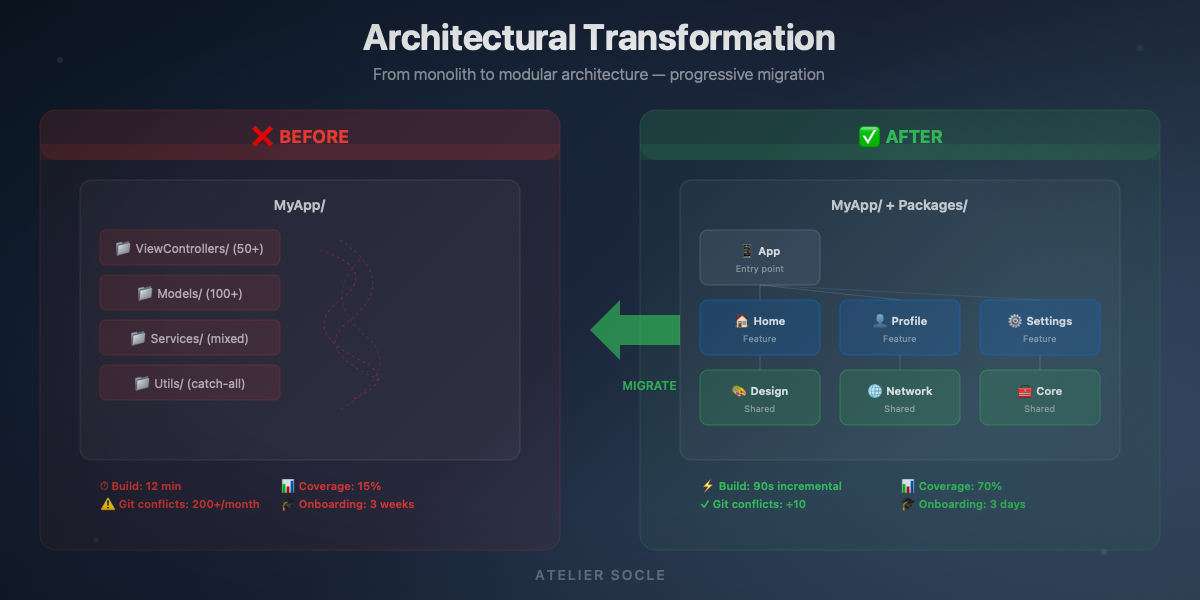
Transformation Example
| Aspect | Before | After |
|---|---|---|
Structure | 1 monolithic target (150k lines) | 12 SPM modules |
Build time | 8 min (clean), 45 sec (incremental) | 2 min (clean), 8 sec (incremental) |
Tests | 2000 tests, 40% flaky | 2500 tests, < 1% flaky |
Team | 6 devs, daily merge hell | 6 devs, 3 autonomous feature teams |
Onboarding | 3 weeks before productivity | 1 week |
Not to be confused with...
- Not app development → see Apple Applications
- Not performance optimization → see Performance & Memory
- Not consulting only → see Technical Coaching
Here, we structure. You leave with an architecture plan and/or a restructured codebase.
Frequently Asked Questions
"Can we modularize without breaking everything?"
Yes. Migration happens module by module, in production. No feature freeze needed. We extract the lower layers first (Core, Shared), then features one by one.
"SPM or Tuist?"
Native SPM for most projects. Tuist if you need complex project generation or advanced features (caching, graphs). I advise based on your context.
"Which pattern to choose?"
It depends. MVVM for simplicity, TCA for rigor, Clean for enterprise. We define this together during scoping.
"Do you code or consult?"
Depends on the format. Audit and plan = consulting. Migration = I code with your team. From scratch = I deliver a bootstrapped project.