SRTKit
Published on · 16 min

When you broadcast a live video feed over an unreliable network — a field contribution, a satellite link, a 4G connection from a stadium — the transport protocol makes all the difference. TCP is reliable but adds latency, UDP is fast but drops packets without warning. SRT (Secure Reliable Transport) combines the best of both: UDP transport with reliability, low latency, AES encryption, and forward error correction.
Created by Haivision and turned into an open standard through the SRT Alliance, SRT is now used by broadcasters worldwide — from live contribution to broadcast workflows and cloud media. The protocol handles handshakes in three modes (Caller, Listener, Rendezvous), end-to-end AES-CTR and AES-GCM encryption, XOR-based forward error correction (FEC), connection bonding for failover, and adaptive congestion control.
While building the Atelier Socle streaming ecosystem — HLSKit for HTTP Live Streaming, IcecastKit for Icecast/SHOUTcast, RTMPKit for RTMP — the last missing piece was SRT. And not a wrapper around C's libsrt — a pure Swift implementation, from UDP transport up to AES encryption, with Swift 6.2 structured concurrency, zero C dependencies, and bidirectional interoperability validated with libsrt 1.5.4.
I looked. Nothing existed in pure Swift. SRTKit was born from that need.
0.2.0 adds native IPv6 support and fixes the StreamID wire format — bytes must be inverted per 4-byte chunk (each chunk is treated as a UInt32 with the first string byte in LSB position). Without this inversion, no libsrt-based server (OBS, FFmpeg, MediaMTX, srt-live-transmit) could read the StreamID correctly.
0.3.0 fixes three fundamental protocol compliance issues. The data packet messageNumber counter — which was fixed at 0 — is now incremented on 26 bits (2²⁶ − 1, value 0 reserved for FEC), resolving the "opened but never publishing" issue with MediaMTX. ACK handling is implemented: the CIF is parsed to extract the last acknowledged sequence number, RTT and link capacity, acknowledged packets are released from the send buffer, and an ACKACK is sent in response. Finally, the Initial Sequence Number (ISN) is generated randomly and independently per direction (local for sending, peer for receiving), per IETF draft §4.3.
What SRTKit does
SRTKit is a pure Swift implementation of the SRT protocol. It covers the entire protocol: connection in three modes, AES encryption, FEC error correction, connection bonding, congestion control, real-time statistics, stream recording, access control, and auto-reconnection. All with strict Sendable conformance end to end. This is NOT a libsrt wrapper — it's a complete implementation from scratch.
Caller/Listener/Rendezvous — Three connection modes for any SRT topology with full handshake negotiation (induction, conclusion, cookie exchange), native IPv4 and IPv6 support
AES-CTR + AES-GCM encryption — End-to-end encryption with PBKDF2 key derivation (RFC 2898), RFC 3394 key wrap, configurable key sizes (128/192/256), and automatic key rotation with pre-announce
Forward Error Correction — XOR-based row, column, and matrix FEC with staircase/even layouts, configurable ARQ modes (always, onreq, never), and
SRTO_PACKETFILTERformat parsingConnection Bonding — Broadcast (all links), main/backup (automatic failover), and balancing (weighted aggregate) groups with packet deduplication and stability monitoring
Congestion Control — LiveCC (packet pacing), FileCC (AIMD with slow start), AdaptiveCC (pattern detection), pluggable architecture via
CongestionControllerPluginprotocolBandwidth Probing — Stepped probe engine with quick/standard/thorough presets, auto-configuration generation, and bitrate monitoring with hysteresis
TSBPD Timing — Time-Based Sender/Buffer/Delivery with clock drift correction, too-late packet drop, and configurable latency
Real-time Statistics — Comprehensive metrics (packets, bytes, RTT, bandwidth, buffers, congestion, FEC, encryption), quality scoring with 5 weighted metrics, Prometheus text exposition, and StatsD datagram export
Stream Recording — Buffered recording with size/duration-based rotation in MPEG-TS or raw format
Access Control — StreamID-based access control with
#!::format parsing and generation (resource, mode, session, user, content type, custom keys)Auto-reconnect — Exponential backoff with configurable jitter and four presets (default, aggressive, conservative, disabled)
Multi-stream / Multi-caller — Route multiple streams over a single listener, manage multiple destinations with enable/disable control
Server Presets — One-line configuration for AWS MediaConnect, Nimble Streamer, Haivision SRT Gateway, OBS Studio, Wowza, vMix, and SRT Live Server
Cross-platform — macOS 14+, iOS 17+, tvOS 17+, watchOS 10+, visionOS 1+, and Linux (Ubuntu 22.04+ with Swift 6.2)
CLI tool —
srt-clifor sending, receiving, probing, statistics, loopback testing, and diagnosticsSwift 6.2 strict concurrency — Actors for stateful types,
Sendableeverywhere,async/awaitthroughout, zero@unchecked Sendableornonisolated(unsafe)Interop with libsrt — Bidirectional interoperability with libsrt 1.5.4 and MediaMTX 1.16.3 validated for both encrypted and unencrypted connections, MPEG-TS H.264+AAC streams
Quick start
Connect to an SRT listener, send data, check statistics, and disconnect:
Installation
Via Swift Package Manager, by adding the dependency to your Package.swift:
Then add it to your target:
Platform support
| Platform | Minimum version |
|---|---|
macOS | 14+ |
iOS | 17+ |
tvOS | 17+ |
watchOS | 10+ |
visionOS | 1+ |
Linux | Swift 6.2 (Ubuntu 22.04+) |
Implemented standards
| Standard | Reference |
|---|---|
SRT Protocol | |
SRT Handshake | |
AES Key Wrap | |
PBKDF2 | |
AES-CTR | |
AES-GCM |
Encrypted caller
AES-256 encrypted connection in CTR mode with passphrase:
Listener
Start an SRT listener and accept incoming connections:
Configuration with Builder
The builder lets you construct a complete configuration with mode, latency and encryption in a fluent way:
Presets
Six built-in presets cover common use cases. Each automatically configures latency, congestion control and socket options:
Server presets
One-line configuration for common streaming servers and software. Each preset automatically configures latency, encryption, buffer sizes, and StreamID format for optimal compatibility with the target product:
AES-CTR encryption
Packet-level encryption and decryption with AES-CTR. The session encryption key (SEK) and salt are used to encrypt each payload independently, using the sequence number as part of the IV:
Forward Error Correction
XOR-based row, column and matrix FEC to recover lost packets without retransmission. Staircase and even layouts, with configurable ARQ modes:
Connection Bonding
Connection bonding lets you aggregate or failover between multiple network links. Three modes are available: broadcast (send on all links), main/backup (automatic failover), and balancing (weighted aggregate):
Statistics and quality scoring
Comprehensive metrics with automatic quality scoring (0.0–1.0, five grades), Prometheus and StatsD export:
Access control
StreamID-based access control with #!:: format for stream routing and authentication:
Auto-reconnection
SRTKit handles automatic reconnection with exponential backoff. Four presets are available, plus custom policies with jitter:
IPv6 & Interoperability (0.2.0)
The SRT caller now binds :: for IPv6 and 0.0.0.0 for IPv4, with correct peer address extraction via SRTPeerAddress — an enum that encapsulates both address families, including IPv4-mapped IPv6 format (::ffff:a.b.c.d).
The StreamID wire format is fixed to match the SRT specification: each 4-byte block is treated as a UInt32 with the first string byte in LSB (least-significant byte) position. This inversion was required for interoperability with any libsrt-based implementation — OBS, FFmpeg, MediaMTX, srt-live-transmit.
Protocol Compliance & MediaMTX (0.3.0)
Three protocol compliance fixes make the connection reliable with third-party implementations.
The data packet messageNumber counter is now incremented on 26 bits (SRT spec field), with wraparound at 0x03FFFFFF and value 0 reserved for FEC control packets. Before, all packets were sent with messageNumber = 0, triggering deduplication on the receiver side.
ACK handling is implemented: the CIF (Control Information Field) is parsed to extract the acknowledged sequence number, RTT, estimated link capacity and available buffer size. Acknowledged packets are released from the send buffer, and an ACKACK (type 0x0006) is sent back to the peer.
The Initial Sequence Number is generated randomly per direction — a local ISN for outgoing packets, a peer ISN for the receive buffer — per IETF SRT draft §4.3.
Interoperability is validated with MediaMTX 1.16.3 — a 3-minute H.264+AAC MPEG-TS stream published from SRTKit caller to MediaMTX listener, 0 errors, 0 buffer overflow. Both StreamID formats are supported: SRT Access Control format (#!::r=live/test,m=publish) used by libsrt and Haivision, and the short format (publish:live/test) used by MediaMTX.
Architecture
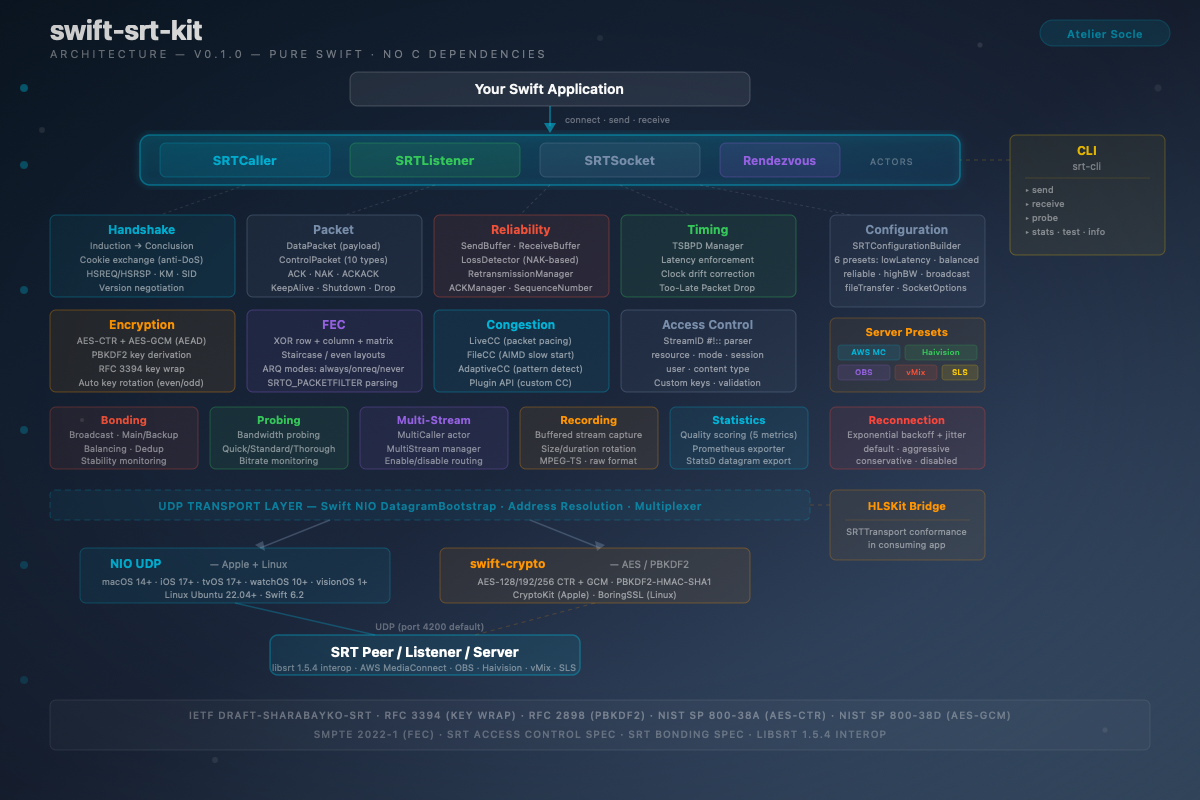
The library is organized into clearly separated modules, each with a well-defined responsibility:
CLI tool
srt-cli provides command-line sending, receiving, probing, statistics, loopback testing, and diagnostics with progress display and structured output.
| Command | Description |
|---|---|
send | Send data to an SRT listener |
receive | Receive data from an SRT caller |
probe | Probe available bandwidth and get recommendations |
stats | Display real-time connection statistics |
test | Run a loopback performance test |
info | Display version and feature information |
Ecosystem
SRTKit is part of the Atelier Socle streaming ecosystem:
PodcastFeedMaker — Podcast RSS feed generation
HLSKit — HTTP Live Streaming
IcecastKit — Icecast/SHOUTcast streaming
RTMPKit — RTMP streaming
CaptureKit — Unified media capture
SRTKit (this library) — SRT streaming
Links
GitHub - atelier-socle/swift-srt-kit: Pure Swift implementation of the SRT protocol. Caller, listener, rendezvous modes with AES encryption, FEC, connection bonding, congestion control, bandwidth probing, and real-time statistics. No C dependencies. macOS · iOS · tvOS · watchOS · visionOS · Linux.
Pure Swift implementation of the SRT protocol. Caller, listener, rendezvous modes with AES encryption, FEC, connection bonding, congestion control, ba…